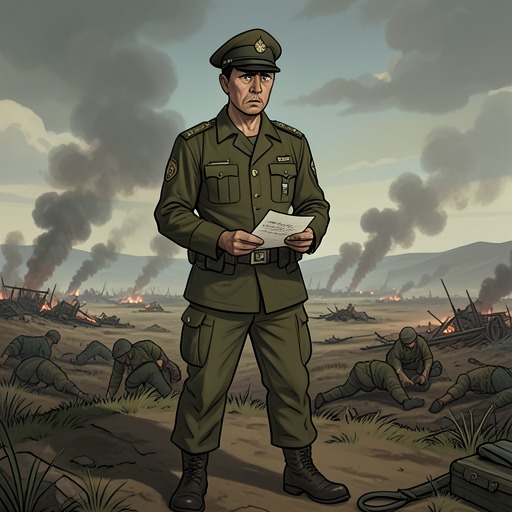
Webb’s letter
The Last of the MohicansWebb’s letter is the captured message that reveals the defenders of Fort William Henry have been abandoned by the relief force they expected. Its blunt counsel to surrender changes the course of the siege: Colonel Munro accepts that resistance cannot be sustained, and the subsequent capitulation promises the garrison an honorable departure that the ensuing violence makes tragically insecure.
Discovery and contents
During the parley with Montcalm, Munro asks whether the French general knows when to expect General Webb’s army. Montcalm answers by extending an open letter and inviting Munro to let Webb speak for himself. The veteran reads it before Duncan can translate Montcalm’s words; Duncan then examines the paper and recognizes Webb’s signature, confirming it as the captured letter.
The message advises a speedy surrender and states that Webb cannot send even one man to the fort’s rescue. Its force lies in the contrast between the defenders’ expectation of support and the plain language of their superior’s refusal. Munro’s expression changes from military pride to deep chagrin, and the letter falls from his hand.
From disclosure to capitulation
Munro interprets the message as betrayal, saying that Webb has brought dishonor upon a household previously untouched by disgrace. Duncan counters that the defenders still possess the fort and their honor, and urges them to make resistance costly. But Montcalm states that retaining the position is impossible and offers terms for the soldiers and their belongings.
Munro authorizes Duncan to settle the conditions. By morning, the fort is to be yielded; the garrison is to retain its arms, colors, and baggage, preserving what military opinion regards as its honor. The letter does not itself constitute the surrender agreement, but its disclosure removes the expectation of rescue that had sustained resistance and makes capitulation the practical course.
Promise and aftermath
The capitulation’s protections are presented as concrete assurances. Montcalm says the defenders’ colors may be carried to England, and promises that the surrender and march will be conducted honorably. Later, Heyward is told to invoke the terms if enemy stragglers intrude upon the women, and to threaten to report misconduct to Montcalm.
Those assurances frame the attack on the withdrawing garrison as a failure of protection. When Magua gives the signal, more than two thousand warriors surge onto the plain; the French troops remain inactive as the violence spreads. The account condemns that inaction as an enduring stain on the French leader’s reputation. Webb’s letter thus stands at the start of a chain in which military abandonment leads to surrender, while the promised security of surrender proves unable to shield the departing garrison.